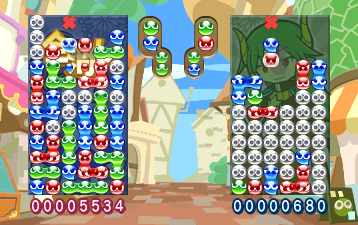
Puyo Puyo Sun - Arcade/Saturn/Playstation (1996)
Japanese Saturn Cover
Puyo Puyo Sun Saturn
Japanese Dreamcast Cover
Puyo Puyo~n Dreamcast
Graphically, Puyo Puyo 4 is clearer, but much more subtle than Puyo Sun, with the characters appearing on the screen a la
Puzzle Fighter. The art style is also a bit less cutesy and bright, but looking much better overall. There's only one
story mode path, but it's quite long. This is made up by a few extra single player modes, including a
task mode similar to Nazo Puyo, and an option for a gigantic playing field. The biggest draw is that four player mode has once again returned, turning Puyo Puyo into one of the best party games around.
While it was originally released on the Dreamcast, it also saw release on the Nintendo 64 under the title "Puyo Puyo~n Party" with a few extra multiplayer modes, and later on the Playstation with the subtitle "Me and Car-kun". Naturally neither of these versions look as
good as the Dreamcast version, due to the lower resolution. The pun in the title of Puyo Puyon is less interesting this time around - "yon" is simply Japanese for "four".
MP3s
Circus Stage - It's Showtime
Puyo Puyo~n Dreamcast
Japanese GBA Cover
Puyo Pop GBA
Puyo Pop GBA
There's also a completely unique story mode, where you run back and forth through a variety of courses, earning prizes (such as galleries) and eventually unlocking the final levels. Given that a lot of the dialogue is actually tutorial entered (plus the relatively light
difficulty level), it's clear that this is aimed towards beginners, though more difficult
levels are still around. There's also a Mission Mode like Nazo Puyo, where your given a time limit and try to reach
as many goals as possible.
By this point, Compile was out of business, so Sega picked up the slack for them. Like many Sonic Team games, there's an option for both Japanese and English language
in all cartridges. However, the English script in the American and European versions is much different from the Japanese one. While undoubtedly purists would find this to be a prime offense, the rewritten dialogue is actually much more amusing, and does a far better job at portraying the wackiness of the series. Here's an example of the speech between Arle and Incubus at the beginning:
Japanese Version:
Incubus: Hi, honey. Where are you off to?
American Version:
Incubus: Hey baby. Come here often?
Amusingly enough, the Japanese version translates the usual losing cry ("batan-kyu") as "baba bing", where it simply becomes "Oh no!" in the other versions.
Puyo Pop GBA
Puyo Pop GBA
Puyo Pop GBA (Japanese)
Puyo Pop Neo Geo Pocket Color
Puyo Puyo Gameboy
Puyo Puyo 2 Gameboy
Puyo Puyo 2 Game Gear
Puyo Puyo 2 Neo Geo Pocket Color
Puyo Puyo Sun Gameboy Color
Puyo Puyo~n Gameboy Color
Puyo Puyo Box
Puyo Puyo Box
Puyo Puyo Box
The Quest Mode is a pure Puyo Puyo RPG. You don't fight enemies normally - you challenge them to a game of Puyo Puyo. Each battle nets you the usual gold and experience, which in turn can be used to upgrade your stats. Higher strength will inflict more nuisance puyos on your opponent, while higher defense will absorb some of your enemy's attacks. You have to be careful not to equip too much heavy equipment however, as they cause your blobs to fall pretty fast.
The plot is the same "find a bunch of medals" stuff in the Madou Monogatari games, although there's plenty of goofiness abound. For example, Arle doesn't just open doors - she bashes through them, sending the door flying into the stratosphere.
Naturally, this mode isn't terribly long, and the dungeons are fairly short and easy, but it's an innovative framework for the Puyo series. I don't see why they couldn't have used better graphics and music for the Quest Mode, especially considering this came out after Puyo Puyo 4 (the battles look/sound like the Puyo 2.) And the random battles can get annoying after awhile. You can run away from most weaker battles, but stronger enemies need to be fought - and since match lasts at least a minute or two, you'd better be in love with Puyo Puyo if you want to stick it through to the end.
Puyo Puyo Box
Puyo Puyo Box
Japanese Dreamcast Cover
Puyo Puyo Fever
Puyo Puyo Fever
Puyo Puyo Fever 2 - Playstation 2, Nintendo DS, Sony PSP (2005)
Japanese DS Cover
Puyo Puyo Fever 2
Puyo Puyo Fever 2
Haro no Puyo Puyo - Gameboy Advance (2005)
Japanese Cover
Haro no Puyo Puyo
Haro no Puyo Puyo
Haro no Puyo Puyo
Random Images:


Minna de Puyo Puyo/Puyo Pop - Gameboy Advance (2001)
The biggest addition to Puyo Puyo 4 are the special attacks. These are all unique to each character, and can include
getting rid of obstacle puyos, shaking the playing field upside down, or eliminating a certain color from your stack.
While it's an interesting idea in theory, it really doesn't pan out. You're not allowed to use special attacks in the
first stages of the Story mode (until you gain some allies and get their attacks), so it's unfairly difficult at the
beginning. And they simply make multiplayer games long and drawn out, as players simply use their attacks over and over
until they can't be charged up any more. This, combined with the slow speed in which the puyos fall, maybe Puyo Puyo~n feel very laid back
compared to the other games. It's less manic, but at the same time, lets you formulate a strategy easier.

Pursuit Stage - Treasure Hunt


Portable Editions:
Unlike all of the other ports of Puyo Puyo, the Gameboy Advance got its own somewhat unique title, known as
"Minna de Puyo Puyo" (Everyone Puyo Puyo) in Japan and "Puyo Pop" everywhere else. Its major feature is four player
action using the system link cable, especially useful since you only need one cartridge - a rarity in GBA link games.
Gameplay-wise, it's almost exactly the same as Puyo Puyo 2, right down to the background style.
Arle: Whatever...Talk about your stuck-up smartalecks.
Incubus: Oh, darling. Even your troubled face is cute in my eyes.
Arle: Jeez...And fifty other lines to get you nowhere.
Incubus: You poor baby... Here let me, beautiful me, warm you up.
Arle: Stop it!
Arle: ....Go away.
Incubus: Hey! I just want to get to know you! What's your sign, baby?
Arle: Octagon. As in "stop".
Incubus: Ooh, I like a girl with a sense of humor! Let's make jokes together...
Arle: That does it.


Being that puzzle games are some of the best titles to play on the go, Compile
ported all of the Puyo Puyos to various platforms. The first Gameboy one was a little bizarre, given that you had to match blobs with
different shapes, making things a bit awkward. This was fixed a bit in
Puyo Puyo 2 by introducing striped blocks, an incarnation which also made it to the
Wonderswan, Game Gear and Neo Geo Pocket Color (which was the first Puyo game released unaltered in America, under the title Puyo Pop.) Naturally, Puyo Sun and Puyo~n look much better than their predecessors in the color incarnations. The screenshots:

Puyo Puyo Box - PSOne(2000)


Puyo Puyo Fever - Dreamcast, Playstation 2, Xbox, Gamecube, Gameboy Advance, Nintendo DS (2004)
In 2000, Compile released an interesting little collection for the PSOne, called Puyo Puyo Box. It includes the Mega Drive versions of Puyo Puyo 1 and 2, along with some Pocketstation games and a four player mode (since this was absent from the PSOne version of Puyo Puyo 4.) None of this is really all that exciting, especially considering they could've ported the arcade versions, but the real highlight is the Quest Mode.


Here's a crossover I'm sure no one expected - Sega combined Puyo Puyo with Gundam to create Haro no Puyo Puyo for the Gameboy Advance. All of the puyos have been replaced by haros (those small goofy flying things) and the characters are super deformed renditions from the original Gundam (none of this Wing or Seed nonsense here.) The gameplay is pretty much the same as the original GBA Puyo Puyo, although it only offers two-player battles. I'm sure this is great for classic Gundam fans, but it's otherwise kinda pointless.

Puyo Beancakes
|
Puyo Puyo~n Cast
|
Madou Monogatari Craziness
|
Waku Waku Dungeon Cast
|